
“Mortality”
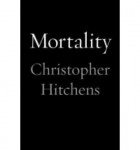
Christopher Hitchens was diagnosed with Stage 4 metastatic esophageal cancer in June of 2010 while on a book tour promoting his most recent memoir – Hitch 22 – (Hitch being his nickname). As Hitchens eloquently points out in one of his many essays on being a cancer patient, “there is no Stage 5” and so he set out to write as much as he could before he passed away.
Mortality was written by Hitchens during the 18 months he was battling the cancer that would take his life. Divided into eight (8) untitled essays, the 104-page book is Hitchens’ attempt to provide a greater understanding of the illness that took him from “the country of the well across the stark frontier that marks off the land of malady.” Realistic that his diagnosis was in effect a death sentence, Hitchens none the less retained a faith in science (and specifically and famously not religion as he was one of the world’s most famous atheists) in hopes of extending his stay on earth.
There are no titles to the chapters but if each chapter had a subject line, it would be along these lines:
Chapter 1: The Diagnosis
Chapter 2: The Role of Religion
Chapter 3: Treatments
Chapter 4: The Etiquette of Cancer
Chapter 5: Finding Your Voice – Freedom of Speech
Chapter 6: That Which Doesn’t Kill You Makes You Stronger – Not Really
Chapter 7: True Awareness
Chapter 8: My Pen, My Voice, My Thoughts
Graydon Carter, the swashbuckler, man-about-town, editor of Vanity Fair and a close friend of Hitchens, wrote the Foreward of the book in which he describes his friend as he knew him: an immensely talented intellectual who could be polarizing; a man who enjoyed his scotch and cigarettes greatly, and most of all – a gifted and prolific writer. Hitchens’ wife, Carol Blue wrote the Afterward which offers another perspective of one of the world’s great debaters: a man who thoroughly enjoyed life and was well-known to say to his varied dinner guests “How good it is to be us” after a raucous dinner banter that spared few issues.
No one knows completely what Christopher Hitchens intended to communicate in his last book because he passed away before it was finished. In fact, the eighth and last chapter ends with a series of thoughts and notes that were printed as they were written right before his death. Topics that ranged from gradual disclosure to the banality of cancer to Alan Lightman’s 1993 novel “Einstein’s Dreams” were written about – albeit brief. Hitchens had a lot more to say and write but he ran out of time; thankfully we are left with a well of good works and a book on how one very talented man who enjoyed life to the fullest dealt with a cancer that took away what he valued most: his pen and his voice. On December 15, 2011, Hutchins died at the age of 62.
Comments are closed.


 Paddock Post
this was a very bad cancer that he had….smoked too-too too much…..lots of booze too……