
What’s in a Chicken McNugget?
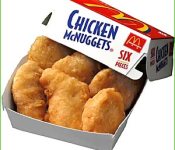
At McDonald’s, we take great care to serve quality, great-tasting menu items to our customers each and every time they visit our restaurants.
Most people think a Chicken McNugget is chicken with breading but a look at the ingredient’s list reveals a different story. McDonald’s publishes an up-to-date list (www.nutrition.mcdonalds.com) of ingredients in their menu items which reveals a Chicken McNugget contains at least 37 ingredients:
White Boneless Chicken, Water, Food Starch-Modified, Salt, Seasoning (Autolyzed Yeast Extract, Salt, Wheat Starch, Natural Flavoring [Botanical Source], Safflower Oil, Dextrose, Citric Acid), Sodium Phosphates, Natural Flavor (Botanical Source).
Battered and Breaded with: Water, Enriched Flour (Bleached Wheat Flour, Niacin, Reduced Iron, Thiamin Mononitrate, Riboflavin, Folic Acid), Yellow Corn Flour, Bleached Wheat Flour, Food Starch-Modified, Salt, Leavening (Baking Soda, Sodium Acid Pyrophosphate, Sodium Aluminum Phosphate, Monocalcium Phosphate, Calcium Lactate), Spices, Wheat Starch, Dextrose, Corn Starch.
Prepared in Vegetable Oil (Canola Oil, Corn Oil, Soybean Oil, Hydrogenated Soybean Oil with TBHQ and Citric Acid added to preserve freshness). Dimethylpolysiloxane added as an antifoaming agent.
Taking each ingredient on its own:
- White Boneless Chicken
- Water
- Food Starch-Modified: starch (usually derived from corn) that has been chemically treated to allow it to act a thickening agent, stabilizer or emulsifier during the processing or storage of food
- Salt
- Autolyzed Yeast Extract: a processed yeast product that is usually used as a flavor enhancer in food.
- Salt
- Wheat Starch: starch (derived from wheat) used as a thickener, extender, or stabilizer in food
- Natural Flavoring (Botanical Source): the essential oil, oleoresin, essence or extractive, protein hydrolysate, distillate, or any product of roasting, heating or enzymolysis, which contains the flavoring constituents derived from a spice, fruit or fruit juice, vegetable or vegetable juice, edible yeast, herb, bark, bud, root, leaf or similar plant material, meat, seafood, poultry, eggs, dairy products, or fermentation products thereof, whose significant function in food is flavoring rather than nutritional (source: Federal Code of Regulation)
- Safflower Oil: an unsaturated fat
- Dextrose: a form of glucose (sugar) derived from starches
- Citric Acid: a preservative
- Sodium Phosphates: the sodium salt of phosphoric acid generally used as a preservative
- Natural Flavor (Botanical Source): see above explanation
- Water
- Bleached Wheat Flour: a refined flour with a whitening agent added
- Niacin: a B vitamin (3) added to the wheat flour to make the flour enriched
- Reduced Iron: iron (added to the wheat flour to make the flour enriched) added in the ferrous form, which is reactive and easily absorbed
- Thiamin Mononitrate: a stable nitrate salt form of thiamine (vitamin B1) added to the wheat flour to make the flour enriched
- Riboflavin: vitamin B-1 added to the bleached wheat flour to make the flour enriched
- Folic Acid: a B vitamin added to the bleached wheat flour to make the flour enriched
- Yellow Corn Flour: finely ground flour made from clean, hulled and degermed yellow corn kernels
- Bleached Wheat Flour: a refined flour with a whitening agent added
- Food Starch – Modified: starch (usually derived from corn) that has been chemically treated to allow it to act a thickening agent, stabilizer or emulsifier during the processing or storage of food
- Salt
- Baking Soda
- Sodium Acid Pyrophosphate: a leavening agent to keep the fats from turning rancid
- Sodium Aluminum Phosphate: a leavening agent to keep the fats from turning rancid
- Monocalcium Phosphate: a leavening agent to keep the fats from turning rancid
- Calcium Lactate: a leavening agent to keep the fats from turning rancid
- Spices: the word is plural so there must be at least 2 spices but the specific spices are not provided
- Wheat Starch: starch (derived from wheat) used as a thickener, extender, or stabilizer in food
- Dextrose: a form of glucose (sugar) derived from starches
- Corn Starch: starch made from corn which can be used as a filler
- Vegetable Oil (Canola Oil, Corn Oil, Soybean Oil, Hydrogenated Soybean Oil)
- TBHQ: an antioxidant derived from petroleum; a form of butane added to preserve freshness
- Citric Acid: added to preserve freshness
- Dimethylpolysiloxane: a suspected carcinogen; flammable, added as an antifoaming agent
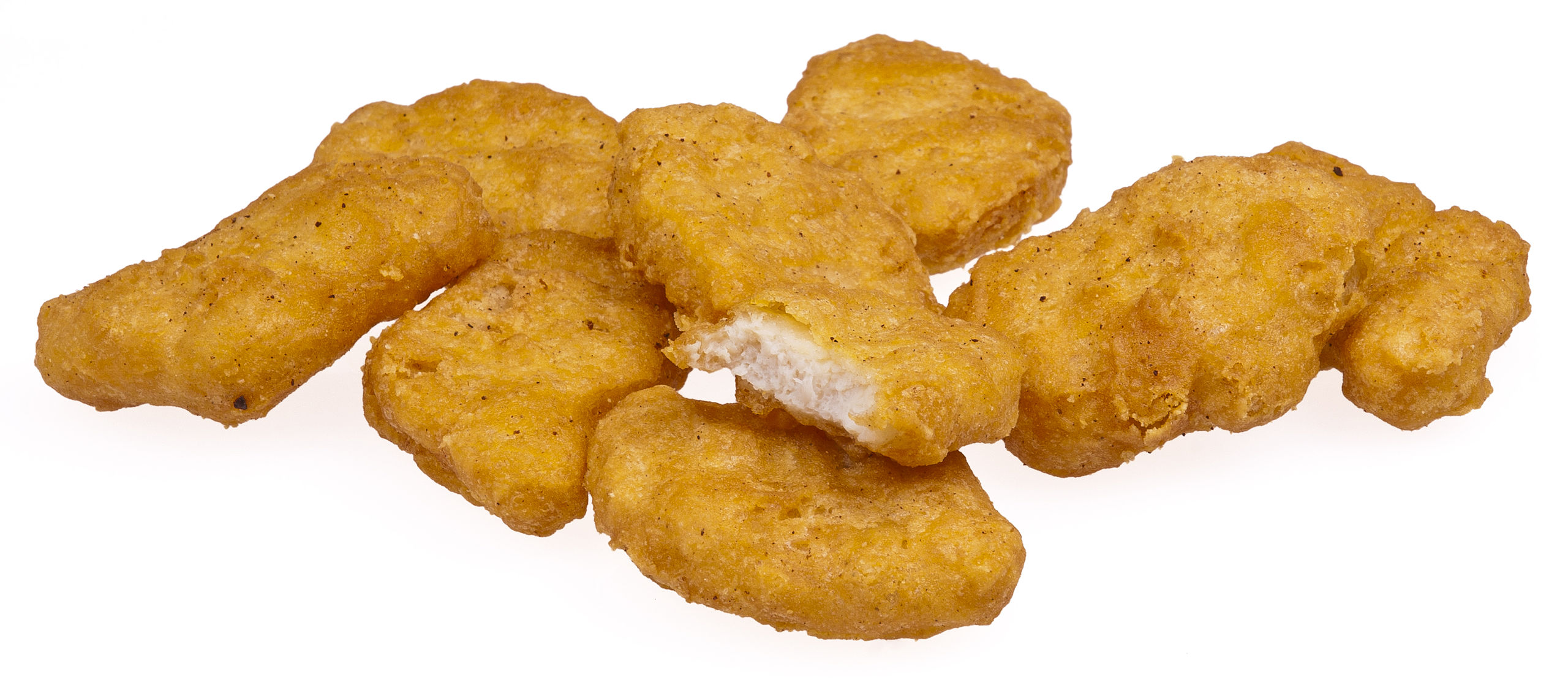 As Michael Pollan points out in The Omnivore’s Dilemma,
……the most alarming ingredient in a Chicken McNugget is tertiary butylhydroquinone, or TBHQ, an antioxidant derived from petroleum that is either sprayed directly on the nugget or the inside of the box it comes in to “help preserve freshness.” According to A Consumer’s Dictionary of Food Additives, TBHQ is a form of butane (i.e. lighter fluid) the FDA allows processors to use sparingly in our food: It can comprise no more than 0.02 percent of the oil in a nugget. Which is probably just as well, considering that ingesting a single gram of TBHQ can cause “nausea, vomiting, ringing in the ears, delirium, a sense of suffocation, and collapse.” Ingesting five grams of TBHQ can kill.
Which begs the question: why does McDonald’s put these additives in food, especially food targeted at kids? I don’t know one parent who would knowingly give their child food with a form of butane or most of the ingredients listed above. If McDonald’s is going to offer a Chicken McNugget (which is estimated to have 50% chicken depending on the analysis source) why can’t it be made without additives? Or better yet, if people stop buying Chicken McNuggets, the company will stop making them. Tell McDonald’s “I’m not loving’ it” by clicking here and telling the company your opinion.


 Paddock Post
Comments are closed.