
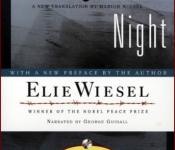
“Night”
NIGHT. No one was praying for the night to pass quickly. The stars were but sparks of the immense conflagration that was consuming us. Were this conflagration to be extinguished one day, nothing would be left in the sky but extinct stars and unseeing eyes.
In May, 1944, 15-year old Elie Wiesel and his family – his mother, father and three sisters – were ordered from their home in Sighet, Transylvania (the central part of Romania) and transported to the Auschwitz concentration camp, and then to Buchenwald. Separated from his mother and sisters, Wiesel and his father managed to stay together for eight months, before his father died in January, 1945. Three months later in April, 1945 the camp was liberated and Elie Wiesel began the journey of “one who has emerged from the Kingdom of Night…” Read more 
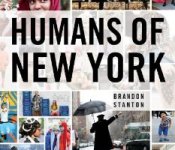
Why You Should Buy “Humans of New York”
Two days ago, Humans of New York (“HONY“), a photography book by Brandon Stanton was released and although the chatter and buzz made me a skeptic initially, HONY really is a book worth buying for the following reasons: Read more
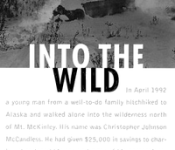
“Into the Wild”
…a challenge in which a successful outcome is assured, isn’t a challenge at all.
In September, 1992 a young man’s decomposing body was found in an abandoned bus in the Alaskan wilderness by a group of hunters. The young man was Christopher “Chris” McCandless (who was also known as Alex Supertramp, a trail name he bestowed upon himself), a 24-year old adventurer who had spent the past four months of his life hunting and foraging in an interior part of Alaska known as the Stampede Trail. When the world learned McCandless was from a well-to-do family in Virginia and an honors graduate of Emory University, people were confounded and perplexed as to what would cause a prosperous, young, well-educated and smart man to lead a nomadic life that would ultimately lead to his untimely death. Read more

Five Chimneys
We lived to resist and we resisted to live.
Five Chimneys was written in 1947 by Olga Lengyel, a 38-year old survivor of Auschwitz-Birkenau who wrote the book as a memoir; a personal account of the year she spent in a concentration camp. In 1944, Olga was living in a small city in Transylvania (which was part of Hungary at the time) with her husband, Miklos Lengyel, a surgeon, their two sons, Arvad (11) and Thomas (9), and her parents when they were told they were being deported to Germany. Read more

“Man’s Search for Meaning”
…a man’s suffering is similar to the behavior of gas. If a certain quantity of gas is pumped into an empty chamber, it will fill the chamber completely and evenly, no matter how big the chamber. Thus suffering completely fills the human soul and conscious mind, no matter whether the suffering is great or little. Therefore the “size” of human suffering is absolutely relative. Read more
“Wave”
During our lifetime, there are certain dates that cause us to remember where we were when disaster struck. For my parents generation, there was November 22, 1963 and for me, there is September 11, 2001 and December 26, 2004.
The day after Christmas in 2004, I was in Guayaquil, Ecuador waiting for a flight to Madrid, Spain. I had just spent the holiday with my family exploring the Galapagos Islands and was planning to continue on with them to Machu Pichu, Peru but I developed a tooth problem and decided instead to return home to Madrid. At the airport, everyone was glued to the televisions with CNN reporting that a horrific tsunami struck Indonesia, Sri Lanka, and the coasts of the Indian Ocean. At the bottom of the television screen was a counter with the estimated number of deaths increasing by the thousands every few minutes. It seemed unreal. Read more

“The End of Your Life Book Club”
Really, whenever you read something wonderful, it changes your life, even if you aren’t aware of it.
Mary Anne Schwalbe has just returned from a humanitarian trip to Pakistan and Afghanistan when she is diagnosed with Stage IV pancreatic cancer which is almost always fatal within months. Unwilling to give up, Mary Anne decides to fight and seeks treatment at Memorial Sloan-Kettering Cancer Center in New York City, where she lives with her husband, Douglas. Her adult son, Will Schwalbe accompanies his mother to her chemotherapy sessions where they pass the hours reading and discussing books they’ve read or are reading. The End of Your LIfe Book Club is Will Schwalbe’s account of the last two years of his mother’s life and how two people – a mother and a son – used books to share, discuss, and disclose their thoughts, feelings, and love for each other. Read more

“Half Broke Horses”
Painting the word “dog” on the side of a pig don’t make a pig a dog.
These words were spoken to Lily Casey Smith, the resourceful, no-nonsense heroine in Half Broke Horses by her husband, Jim Smith after she buys a used hearse and paints the words “School Bus” on the side. That hearse may not have technically been a school bus but for Lily – who could see past its intended purpose and envision piling children in the back – those painted on words let the world know she was a force to be reckoned with. If she wanted a hearse to be a school bus, by God it was going to be a school bus. Read more
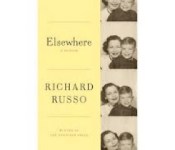
“Elsewhere”
Reading was not a duty but a reward, and from that I intuited a vital truth: most people are trapped in a solitary existence, a life circumscribed by want and failures of imagination, limitations from which readers are exempt. You can’t make a writer without first making a reader, and that’s what my mother made me.
Those are the written words of Richard Russo, the Pulitzer prize-winning author of Empire Falls and most recently Elsewhere – a memoir of his life as the son of Jean Russo – a woman he credits with directing his life into a field where being “obsessive, dogged, and rigid” are assets rather than liabilities. Read more
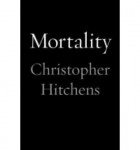
“Mortality”
Christopher Hitchens was diagnosed with Stage 4 metastatic esophageal cancer in June of 2010 while on a book tour promoting his most recent memoir – Hitch 22 – (Hitch being his nickname). As Hitchens eloquently points out in one of his many essays on being a cancer patient, “there is no Stage 5” and so he set out to write as much as he could before he passed away. Read more


 Paddock Post