
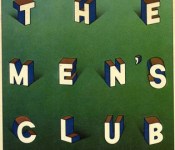
“The Men’s Club”
Brotherhood is exclusive, not universal.
35 years ago, men rarely sought out each other’s company outside of a sporting event, a bar, or a bachelor party. While women were leaning on each other and seeking camaraderie in Mommy & Me events, book clubs, and aerobic classes, men went to work, fulfilled family obligations, and briefly escaped to society sanctioned events which did not generally include meeting at one of their homes for a men’s club get together. So, when a group of seven men – a retired professional basketball player, a tax accountant, a lawyer, two psychotherapists, and two college professors – come together to form a men’s club – “a regular social possibility outside of our jobs and marriages,” there is curiosity and reluctance to take a road less traveled, as depicted in the fictional novel, The Men’s Club. Read more 

“The Wife of Martin Guerre”
…when hate and love have together exhausted the soul, the body seldom endures for long.
While scouring the shelves described as “classics” in an independent bookstore (Mac’s Backs-Books on Coventry) in Cleveland Heights, Ohio, I discovered The Wife of Martin Guerre by Janet Lewis (a poet and writer who lived from 1899-1998). On the back cover of the book were the words: Read more
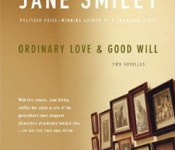
“Ordinary Love and Good Will”
But it is not necessarily the ones you love the most that have the most effect on you.
Jane Smiley, Pulitzer prize-winning author of A Thousand Acres published Ordinary Love & Good Will – two short stories that explore the effects that people’s actions have on their children – in 1989. Although the stories are very different, the reader can’t help but see the long-lasting and indelible effects on the children of adults who don’t think about their behavior and consequences, who think of themselves first, who can’t control their urges, and who are often in denial. Read more
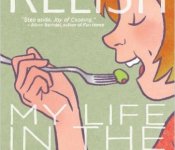
“Relish”
Graphic novels are not traditional literature, but that does not mean they are second-rate. Images are a way of writing. When you have the talent to be able to write and to draw, it seems a shame to choose one. I think it’s better to do both. ~Marjane Satrapi
Several months ago, my daughter told me she was reading a graphic novel and I’m ashamed to admit I thought she was reading a book with a triple “X” rating attached to it. Always trying to be open-minded, I asked a few questions and realized a graphic novel is simply a novel in comic strip format. Totally embarrassed by my ignorance, I made a note to self: stay better informed of current trends in young adult culture. Read more

“The Widow’s Children”
But once in the world, she learned everyone’s lesson – families were not as they seemed, she grew artful in spotting the cracks in domestic facades. Wasn’t everyone damaged….
For many years, a book – The Widow’s Children – sat on a shelf in my bookcase untouched because I had read that the author – Paula Fox – tended toward the somber although many critics consider Fox one of the greatest writers of the 20th century. Most of Fox’s works were published in the 1960’s, 70’s, and 80’s, so many of her books are out of print which means Fox is not as well-known as she was 30 years ago. Read more

“Tell Everyone I Said Hi”
A taste of honey is worse than none at all. ~Lionel Richie from I Second that Emotion
There are people who love a quick fix whether it be a piece of dark chocolate, a cup of espresso, or a short story that can be read in its entirety in ten minutes or less. Not that a whole chocolate bar, a mug of coffee or a 600 page novel aren’t fantastic – they certainly are – but there are times when a “hit” just makes your day a little happier and more satisfying. If you happen to agree, then Tell Everyone I Said Hi is the book for you. Read more
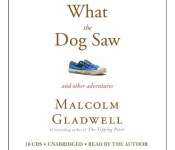
“What the Dog Saw and Other Adventures”
A lot of my process is informed by the notion that two mildly good stories put together sometimes equal one really good story.
What the Dog Saw and Other Adventures by Malcolm Gladwell was published in 2009, although the 19 non-fiction essays included in the book were originally published in The New Yorker magazine where the author has been a staff writer since 1996.
Divided into three parts with three themes: obsessives, theories (ways of organizing experience), and the predictions we make about people, What the Dog Saw and Other Adventures is one of the most interesting contemporary collections of stories that anyone over the age of 40 can relate to without having to refer to Wikipedia for an explanation of events, characters, products, and businesses. Read more
“The Lovers Set down Their Spoons”
They weave through the tables – their rain coats billowing out behind them like the kites you and I flew on that terrible day that began our love. Your kite kept wrapping around mine, and at first I thought it was sweet, but eventually mine nosedived into the sand.
In 2014, the Iowa Short Fiction Award was given to Heather A Slomski for The Lovers Who Set Down Their Spoons, a collection of 15 short stories that are thought-provoking, captivating, and haunting. Themes of love, loss and regret are heavily emphasized with symbolism and metaphors used to convey the message in the narratives that vary in length from 2-29 pages. Read more
“Franny and Zooey”
An artist’s only concern is to shoot for some kind of perfection, and on his own terms, not anyone else’s.
Franny and Zooey is actually two short stories that were originally published in The New Yorker magazine: Franny, in the January 25, 1955 issue, and Zooey, in the May 4, 1957 issue. Written by J.D. Salinger, Franny and Zooey was published as a 2-chapter book in 1961 and is both a perplexing yet satisfying read that explores the meaning of life in its spiritual context. Read more

“The Girl on the Train”
Imagining something is better than remembering something. ~John Irving, The World According to Garp
Summertime is when everyone seems to be talking about “beach books”, which I never fully understood until I read The Girl on the Train by Paula Hawkins. The Urban Dictionary defines a “beach book” as “easily digestible, designed to be guzzled down from a cramped airline seat or reclining poolside chair” and although that definition seems more like a description of a beer to me, I finally realized that a beach book is like a refreshment or some tangy pineapple that may momentarily satisfy hunger when descriptive prose and depth are just too much to think about. Read more


 Paddock Post