

“The Little Friend”
…it was Christmas, there was a new baby in the house, everybody was happy and thought they would be happy forever.
Harriet Cleve Dufresnes had just entered the world as the third child of Charlotte and Dixon Cleve. Four months later, while baby Harriett was strapped in her swing on the front porch with her 4-year old sister, Allison playing nearby, 9-year old Robin was found hung from the tupelo tree in the front yard while the rest of the family was in the house setting up the table for a Mother’s Day celebration. No one saw or heard a thing. Read more 

“Niki: The Story of a Dog”
Affection is not only a pleasure for the heart but also a burden which, in proportion to its importance, may oppress the soul quite as much as it rejoices it.
Long before books like Marley or The Art of Racing in the Rain appeared on bookshelves, a book entitled Niki: The Story of a Dog was written in Hungarian by Tibor Déry and published in 1956, shortly before the October Uprising, a nationwide revolt against the Soviet-controlled government in Hungary. In the years following World War II, Hungary underwent massive political changes and it is these changes the reader sees through the eyes of the narrator who tells the story of a middle-aged couple who adopt a street dog named Niki. The story begins in the Spring of 1948 and ends six years later in 1954. Read more

“Life and Times of Michael K”
The Life and Times of Michael K was written more than 30 years ago (1983) by J.M. Coetzee and yet, the story is as relevant today as decades ago. Freedom from both persecution and charity are the overriding themes of this fictional story that takes place in South Africa when the minority Black South Africans were fighting against apartheid during a civil war. The years are irrelevant as the timeframe could be any decade and any place where there is one set of rules for the majority in power and another set for the oppressed minority class. Read more
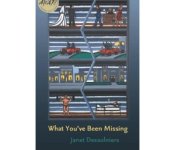
“What You’ve Been Missing”
Never judge a book by its cover…..
The cover art of What You’ve Been Missing is a painting by Roger Brown called It’s a Wonderful Lie and is as telling as the short story collection written by Janet Desaulniers. A rectangular piece of art divided into eight sections, It’s a Wonderful Lie depicts life as we live and the impending disaster ahead: we come together and marry; we divorce and part; we enjoy a drive in a convertible and unexpectedly get hit by a truck; we run our businesses and we go to jail; and finally, we exercise and strengthen our bodies only to succumb to death. Read more

“Model Home”
What an odd thing a family was,…The permutations, like the patterns of a chess game, seemed endless.
The Ziller family – Warren and Camille and their three children: Dustin, Delilah (“Lyle”), and Justin, and Mr. Leonard, an old and arthritic dog – left their hometown of Nashotah, Wisconsin in 1982 to move to a suburban development outside of Los Angeles, California. In pursuit of success and wealth, Warren Ziller invests everything in a real estate development – Auburn Fields – that ends up being adjacent to a dump. Three years later (1985) Warren has lost everything but is afraid to tell his family who all seem to be completely unaware of what is going on around them. Read more

“Friendly Fire”
..honey, this is life. You learn to live with guilt. You do the best you can. Believe me, you don’t get away with anything in this life. You’re going to pay the price, so you make sure you get your money’s worth.
Friendly Fire, a collection of 11 short stories written by Kathryn Chetkovich was awarded the John Simmons Short Fiction Award from the University of Iowa. Although 16 years have passed since the book was published, this treasury of short stories is as relevant today as when they were first read in 1998. Forthright but with a subtle message and often open-ended, these stories don’t have twists or imply completion primarily because the stories deal with tough issues: envy, irony, dishonesty, loyalty, teenage angst, aging, friendship, marriage, love, lust, and responsibility – highly charged emotions that inspire loose ends and don’t take well to predictability. Read more
“The Interestings”
From this day forward, because we are clearly the most interesting people who ever lived, because we are just so fucking compelling, our brains swollen with intellectual thoughts, let us be known as The Interestings. And let everyone who meets us fall down dead in our path from just how fucking interesting we are. Read more

“The Woman Upstairs”
I’ve finally come to understand that life itself is the Fun House. All you want is that door marked EXIT, the escape to a place where Real Life will be; and you can never find it. No: let me correct that. In recent years, there was a door, there were doors, and I took them and I believed in them, and I believed for a stretch that I’d managed to get out into Reality – and God, the bliss and terror of that, the intensity of that: it felt so different – until I suddenly realized I’d been stuck in the Fun House all along. I’d been tricked. The door marked EXIT hadn’t been an exit at all. Read more

“Leaving The Atocha Station”
No writer is free to renounce his political moment but literature reflects politics more than it affects it, an important distinction.
Ben Lerner was 24 years old when he traveled to Madrid, Spain on a Fulbright Scholarship in 2003. A recent graduate of Brown University with a B.A. in Political Theory and an M.F.A. in Poetry, Lerner may have chosen Spain because of its troubled past – many poets writers, and artists were murdered, jailed, or forced into exile during the Spanish Civil War (1936-1939) – or because the country offers a unique perspective on politics, fascism, and terror – all of which make Spain a rich playground for those in the arts. Read more

“Glow”
It is October 31. Halloween. I have long lost my love of masks and phantoms.
So says, 26-year old Amelia “Mia” J. McGee, a woman of Cherokee and Scotch-Irish descent, and a writer for the NAACP and WEB in Washington, DC who has returned to Hopewell County, Georgia to find her missing 11-year old daughter, E.F. “Ella” McGee. Three days prior a rock had been thrown through the McGee’s window with a note that said “The next one won’t be a rock.” Fearing for her daughter’s life, Mia put Ella on a bus to Georgia and arranges for her brother, Buddy to pick up the child at the bus station. But when Ella doesn’t make it, Mia decides to vacate her plans to march in the largest picket in Washington, D.C.’s history on October 31, 1941 and return to her childhood home to find the little girl she named after Elizabeth Freeman, “the great suffragist and speaker.” Read more


 Paddock Post