
“Sarah’s Key”

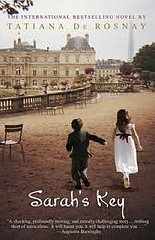 “Sarah’s Key” was written by Tatiana De Rosnay and published in 2007. The story begins in Paris on July 16, 1942 during the Vel’ d’Hiv’ police roundup. The words “Vel’ d’Hiv'” refers to the Vélodrome d’Hiver, an indoor cycling stadium that was used to hold 13,152 Jewish citizens – mostly women and children – that were rounded up by the French police under a Nazi decree before being sent to concentration camps – primarily Drancy and Auschwitz. The Vélodrome d’Hiver was located in the 15th arrondissement, near the Eiffel Tower (see the red dot in the photo below) and as such, in full view of the public which is crucial in understanding the horror of the roundup.
After the military defeat of France by Germany in 1940, Marshal Philippe Pétain proclaimed the Vichy regime the governing force of France. As such, the Vichy government cooperated with the Nazis during the war. The Germans ordered a census in late 1940 which allowed the Vichy regime to determine who and where the Jewish citizens were and this was crucial to the “success” of the Vel’ d’Hiv’ police roundup. The most disturbing part of the roundup is that the French police planned, coordinated and conducted the roundup under the watchful eye of the Nazis. This was the second crucial element in understanding the horror of the Vel’ d’Hiv’ – that not only was the roundup and containment done in full public view, but that it was done by the French police.
“Sarah’s Key” is the story of a 10-year old girl, Sarah who locks her 4-year old brother, Michel in a bedroom cabinet – their secret hiding place – to protect him from the policewho have come to take them away. Thinking that she will return quickly, Sarah promises to come back for Michel and feels an enormous responsibility to return but is unable because the family is kept at Vélodrome d’Hiver for several days and then transported to a concentration camp. Undeterred, although sick and weak, Sarah plans to get back to Paris to release her brother.
Sixty years later, the story of Sarah Starzynski and her family intertwines with the new occupants of the same apartment: Julia Jarmond, an American journalist who has spent most of her adult life in Paris, her husband Bertrand Tézac, and their daughter Zoe. While researching an article on the Vel’ d’Hiv’, Julia uncovers information on the history of the apartment with the secret bedroom cabinet and the story unfolds in a cohesive alternate chapter approach between Sarah’s struggle and Julia’s search.
The story is fiction but the truth of what happened in the summer of 1942 in Paris is the heart of the story. The Vélodrome d’Hiver is gone – partially destroyed by a fire in 1959 and then demolished for no one wanted to be reminded of the horror of that summer (which was difficult when the Vélodrome d’Hiver was in the middle of Paris). But through stories like “Sarah’s Key”, the world won’t forget that a group of people were singled out because of their religion and then persecuted, tortured, and killed.
The movie was good but the book was better, which is usually the case. Written in a very straight forward short sentence style, “Sarah’s Key” is much more horrific in writing than the movie suggests although my husband almost walked out during a particularly strong scene in the beginning of the movie. His comment: “if the movie was any stronger, no one would go see it.” So, I was reminded that Hollywood makes movies to entertain; educating the public is secondary.


 Paddock Post
Comments are closed.