
“The Colonel”
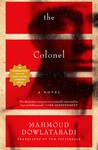
The Colonel was written by Mahmoud Dowlatabadi, a Tehran-based writer and an Iranian professor of Literature who is a leading proponent of social and artistic freedom. Banned in Iran, the original version of The Colonel was written in Persian and published in Germany before being translated in English by Tom Patterdale. Recently released (April, 2012) in the United States, The Colonel is the story of a man who served in the Shah’s army and who condemns himself for committing two mortal sins in his life: killing his wife who committed adultery and refusing an army order to go to Dhofar (a province in southwest Oman) to “slaughter a bunch of hungry rebels on the grounds that they were a Soviet threat” (the Soviets had a substantial base there at the time) in 1973.
Dishonorably discharged from the army, the colonel is sent to prison for the murder of his wife during the reign of the Shah. While in prison, he is reunited with his eldest son, Amir who was imprisoned for belonging to the orthodox communist Tudeh party. In 1979, the Shah was deposed by the Islamic Fundamentalists led by the Ayatollah Khomeini resulting in the release of prisoners, including the colonel and Amir. Father and son return home both broken men – the colonel from his disillusionment with the changing political parties whose brutality only seems to worsen; and Amir who was cruelly tortured in prison.
The story begins on a rainy night with a knock on the door of the colonel’s home by the Caspian Sea. Two police officers have come to take him to the prosecutor’s office to claim the body of his 13-year old daughter, who was tortured and hanged after sympathizing with a group of political figures targeted by the regime and becoming infatuated with a leader. On his mantel is a full length portrait of the Colonel (Colonel Mohammad-Taqi Khan Pesyan)- a man he revels – along with pictures of his wife and five children, three of whom are now dead: Mohammed Taqi who was a communist supporter and was executed; Kuchik Masooud, who supported Khomeini and died in war; and now his youngest, Parvaneh, a mere child. Reluctantly, the colonel goes with the officers to the station to claim the body and accompany the police officers to the cemetery where the child must be washed and buried before sunrise. With no female present to wash the body, the colonel entrusts “her” to the officers while he returns to town to convince his older daughter to come to the cemetery – after he picks up a pick and a shovel so he can dig her grave.
The twentieth century was a tumultuous time in Iran but the years between 1978 – 1988 were particularly brutal. It is this decade in which the story unfolds. The story of “The Colonel” takes the reader from the disillusionment with the reign of the Shah through the rise of the fundamentalists to the slaughter of the liberals in 1988 and the ultimate recognition that the new regime is worse than the previous. The young bought into the idea of revolution for change and violence became a national pastime with little regard for life as the opposing parties fought for power. The colonel allowed his children to pursue their own ideological paths and find their way only to realize that “he had willingly sacrificed his children to this country, even though they had ultimately fallen victim to a vile conspiracy.” Their lives were for naught and there are moments as the colonel is losing his mind when he wishes he never had his children for how does a parent bury child after child and continue living?
Prior to reading the book, there are five important pieces of information a reader needs to know:
- There are two colonels in the book: the protagonist and unnamed father of five who was a colonel in the Shah’s army; and Colonel Mohammad-Taqi Khan Pesyan who is admired by the unnamed father of five. The protagonist is referred to as “colonel” in the lower case whereas Mohammad-Taqi Khan Pesyan is referred to as the “Colonel” in the upper case.
- When the writing is in Italics, the voice is one of the characters – primarily the colonel or one of his sons.
- Before starting the novel, read the “Afterward” in the back of the book. Written by Tom Patterdale who translated the novel, this 12 page section provides valuable background information on the author, when and why the book was written, where the story takes place, a brief history of modern Iran, and an understanding of the colonels and the principal characters. This section is enormously helpful in understanding the novel.
- Since the original novel was written in Persian, the Persian culture is an integral part of the novel. The translator did not change key Persian words that are not translatable. Instead, he keeps the word and adds a footnote with an explanation. The footnote section is in the back and is a great resource in helping the reader understand Persian history, holidays, culture, and customs.
- At times, the novel seems to be fractured with flashbacks, hallucinations, and the inner thinking of characters which seems to symbolize how fractured Iran was at the time. Stay with the novel and read the footnotes as there are key sentences that can easily be missed if quickly read over.
My understanding of Iran prior to reading The Colonel was limited to what I knew from my Persian friends who chose to live primarily outside of Iran and the generally accepted conclusion that the current leader is a lunatic. After reading the book, I had a much better understanding of modern Iran – a country that was occupied and controlled by Britain, Russia, and the US for nearly a century because of the oil resources. In their struggle to be free of foreign rule or interference, the Persian citizens have truly suffered at the hands of the Islamic fundamentalists who ultimately gained power.
….but I know this much, that young birds get lost in the wind, particularly in a west wind. It confuses them and makes them giddy, it ties them up in knots and they lose their sense of direction and, in their struggle to find their way, they break their wings. And in a storm there is no shortage of hawks and vultures looking for prey.


 Paddock Post
Comments are closed.