
The Pen/O.Henry Prize Stories
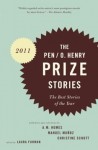
The art of the great short story is well presented in “The Pen/O.Henry Prize Stories” – a collection of twenty short stories chosen annually by a Series Editor (Laura Furman has held the position since 2003). The criteria? All stories had to have been written originally in English and published in an American or Canadian periodical. Widely regarded as one of the most prestigious awards for short fiction, the Pen/O.Henry Prize Stories offer readers some of the finest examples of short fiction written in any given year.
The 2011 collection includes a wide variety of stories that reflect contemporary times, historical days gone by and the futuristic; yet the real story is always character driven. In ‘Something You Can’t Live Without,” a traveling salesman makes his living by conning the “..daft, gullible, and insane” until he meets his match. And in “Sunshine,” wealth shields a South African ruler who practices his own kind of sick brutality on the young which leads to a surprising conclusion. In “Never Come Back,” a middle-aged man who surrendered to his wife, family, and outside forces finds a new purpose in life caring for his young grandson but realizes the time with the little boy – like everything else in his life – is fleeting.
Relationships are a common theme in stories and no less so in “Ice” – a short story about a couple in their 60’s on a cruise to Antarctica. There is no better backdrop to the story than the icy glaciers which seem to be a metaphor for their long marriage and cold feelings towards each other. In “Bed Death” two women go to Malaysia to find work as teachers and to be together but don’t find the work or the relationship as expected. The title of the story – “Bed Death” is used to describe what happens long before a lover physically removes herself from a shared bed. In “Pole Pole” a young woman arrives in Kenya and dives into a passionate sexual relationship with a man who is not hers to have. And, in “Nothing of Consequence” a middle-aged widow goes to Madagascar to teach. Once there, she meets a student – a younger man – who does not see past the surface of things and yet years later when the younger man publishes poetry and wins a prestigious award, the other teachers read the book scouring for clues of the illicit relationship between the teacher and the student of years past.
There are several short stories where the location of the story is of particular importance. In “Your Fate Hurtles Down At You” four avalanche researchers are living in a small hut 9,000 feet above Davos, Switzerland in 1939. They call themselves “the frozen idiots” for they know “tonight, or tomorrow night, or some night thereafter, the slopes above…will lose their patience and sound their release.” In “The Restoration of the Villa Where Tíbor Kálmán Once Lived” the story is set in Hungary during World War II. The protagonist is a young Hungarian who survives his service to the German army and then to the Soviets occupying his country by his willingness to do anything to survive. He is provided a villa once owned by a Hungarian war hero and he sets out to restore the large house to its previous grandeur but dreams have a way of disappearing, just like people. And in “How to Leave Hialeah” a young woman narrates the story in which she plots and succeeds in leaving Hialeah, Florida where her Cuban-American family calls home only to find other roadblocks in her ambitious dreams to escape her ethnicity.
The role of families in our lives play a particular importance in several short stories. In “Alamo Plaza,” the narrator tells the story of a family vacation in Gulfport, Mississippi but with the knowledge of the future (which he tells the reader on the first page). The characters in the story – his mother, father, and two brothers are both who they are in the past and what they will become. “Windeye” is the story of a little boy’s steadfast belief in make-believe – a belief that his sister existed – even when everyone else tells him otherwise. And, in “The Crossing” a divorced father goes camping with his young son only to encounter the terror of making a bad decision. So often, short stories of young people focus on the mistakes of the young while the adults – and specifically parents – are not supposed to make the stupid mistakes that lead to a crisis.
“The Rules Are the Rules” tells the story of a cynical priest who has not come out of the closet in his suburban London congregation. He is cruel to the young who are weaker and angry at the rules that bind him to his chosen profession. In another dark story called “The Black Square” a young man travels to Nantucket where those that want to commit suicide may do so by passing through a black square (a black hole of sorts). At times hilarious – as the narrator of the story explores what happens when someone gives up their social filters – and other times sad, the surprise ending is a welcome conclusion. “The Diary of an Interesting Year” reminded me of “The Road” by Cormac McCarthy – in which the reader is introduced to a world and a society that has been changed forever by some awful event. Narrated by a 30-year old woman in 2040, the story starts off on a somewhat normal tone but then takes on a gradual but increasingly fast pace to explain what happens to people when society collapses.
The final four stories – “The Vanishing American,” “Melinda,” “The Junction,” and “Nightblooming” – are equally interesting and satisfying although my favorite of the last group was “Nightblooming” – a very funny story about a young musician who joins a band called the “Nightblooming Jazzmen” – a group of five elderly musicians who allow the newest member to take on the role of a fellow Nightbloomer. After a gig, the Nightbloomers take 22-year old Tristan – who they have renamed “Stanley” – to a party with a group of elderly women. At first Tristan feels like he’s “…eight years old – a little kid with a whole army of grandparents” but that feeling changes as the hours pass by and he loses himself in their company admitting “…maybe it’s just about he best party I’ve ever attended.”
Short stories are like having a piece of slightly chilled red velvet cake in the late afternoon – a scrumptious treat in between two meals that makes it all the more satisfying. Reading an 8, 12 or 15-page short story doesn’t require a lot of time and yet, a well written short story is immensely pleasurable – especially when the story is a Pen/O.Henry Prize Story.


 Paddock Post
Comments are closed.