
“Elsewhere”
Reading was not a duty but a reward, and from that I intuited a vital truth: most people are trapped in a solitary existence, a life circumscribed by want and failures of imagination, limitations from which readers are exempt. You can’t make a writer without first making a reader, and that’s what my mother made me.
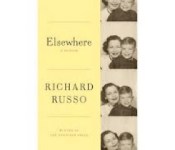
Those are the written words of Richard Russo, the Pulitzer prize-winning author of Empire Falls and most recently Elsewhere – a memoir of his life as the son of Jean Russo – a woman he credits with directing his life into a field where being “obsessive, dogged, and rigid” are assets rather than liabilities.
Single motherhood was a rarity in small New England towns in the 1950’s when Jean Russo decided to take the road less traveled. Briefly married to a compulsive gambler, Jean opted to raise her son in Gloversville – a small town in upstate New York that garnered its name from the tanneries and leather glove factories that allowed the town to thrive up to the middle of the twentieth century. Being a woman alone was difficult enough but being a woman supporting a child was exponentially more difficult because opportunities for women were so limited at the time. Pay scales were different and the glass ceiling was low but Jean Russo wouldn’t give up.She had her parents in the apartment below and her sister down the street who she relied on heavily while working full-time for GE in Schenectady.
For those familiar with Russo’s writings, the setting of Elsewhere in a small dying town in upstate New York rings familiar except in this book, the narrative is non-fiction. Russo looks back with love, affection, appreciation, frustration,and guilt in describing a dysfunctional family that loosely divided themselves between the ill and the enablers without having the self-awareness of knowing who was who. Jean Russo was a woman who “valued few things more than her perceived independence” and yet throughout her life in moments of despair, she would descend into self-pity and plead “Doesn’t it matter that I’m a person? Don’t I have a right to a life, like anybody else? How long am I expected to live in a cage?”
The cage was Gloversville – the town she both grew up and raised her son in; the town in which she felt both stifled and loved. There was never enough money or opportunity which led her to periodically escape thinking the grass was always greener on the other side only to return in defeat. Ever the eternal optimist, Jean Russo convinced herself things would be different but she failed to recognize her worst enemy was herself, her decision-making process or what her son calls her “sequencing” which always led to defeat. As the author states “there were two Gloversvilles- the one she was always trying to escape from when she lived there, and the other she nostalgically considered, every time she fled, as home.”
Jean Russo blamed others for her difficulties and felt she was owed a better life but the only good life she ever found was in books, reading being a passion she shared with her son although each had distinctly different tastes in literature. How ironic that reading and books gave Jean Russo a mental escape from her mundane and depressing life while giving her son a complete escape from Gloversville to the world of teaching and literature. She blamed others; he saw opportunity. Looking back 60 years, the author realizes
the mechanism of human destiny – that intricate weave of chance and fate and free will, as distinctly individual as a fingerprint – is surely meant to remain life’s central mystery, to resist transparency, to make blame a dangerous and unsatisfactory exercise.
Richard Russo was his mother’s “chief emotional guardian” and he never abandoned the mother who clearly put too much of her own baggage onto him but he certainly felt and continues to feel the guilt of being an enabler to a mother who needed psychological assistance. As Russo points out “her mantra had always been that we were a team, that as long as we had each other, we’d be able to manage.” And, manage they did.


 Paddock Post
Comments are closed.