
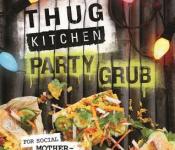
Thug Kitchen Party Grub
Gotta bake bread to break it.
There are four aspects essential to a good cookbook (meaning a cookbook that spends more time on the countertop than on a book shelf).
- First, the cookbook must contain colorful pictures of the finished product. Pictures inspire cooks to take the leap and make the dish and although my finished dish may not look as polished as the one in the cookbook, there is usually a close resemblance (note: all of the pictures below of the finished dishes were made by me).
- Second, the recipes have to call for mostly fresh and easily recognizable ingredients. No strange ingredients that require a special trip to search the aisles of specialty markets are allowed.
- Third, the recipes can’t be too complicated because who wants to spend hours making dishes that everyone devours in 15 minutes?
- And, finally the food has to taste really good as in “delicious, can I have seconds; this recipe is a repeat.” Read more

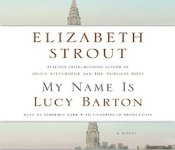
“My Name is Lucy Barton”
Elizabeth Strout – the Pulitzer Prize winning author of Olive Kitteridge and The Burgess Boys, recently published My Name is Lucy Barton, a novel that explores one person’s emotional quest to connect with her mother. Told from the perspective of Lucy Barton, the 188 page novel tells the story of a woman who longed to escape her childhood and become a writer in New York City. Along the way, she marries and has two daughters, embracing motherhood. When she enters a hospital to have a routine appendectomy, a complication arrises that results in a 9 week hospital stay. While her husband is busy working and her two young daughters cared for by an overzealous nanny, Lucy whiles away the days until her mother shows up to visit – a mother she hasn’t seen since she before she was married. Read more
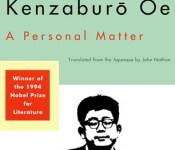
“A Personal Matter”
Every time you stand at a crossroads of life and death, you have two universes in front of you, one loses all relation to you because you die, the other maintains its relation for you to survive in it.
Kenzaburō Ōe is a Japanese writer of essays, short stories, and novels that primarily deal with social, cultural, political, and philosophical issues. Born in 1935, Ōe has had many of his works translated into English and was awarded the Nobel Prize for Literature in 1994. Influenced by Kafka, Twain, Lagerlöf, and a host of French writers, Ōe often writes of the desire for adventure, the mundane parts of life, and the truly horrific parts of our existence in a nuclear age. But, the biggest influence on Ōe’s literary career seems to be his firstborn son, Hikari. Read more

“More Great Good Dairy-Free Desserts Naturally”
Eat your fruits and vegetables but make sure you leave room for dessert, as long as the dessert tastes excellent and is made with healthful, honest ingredients…
Imagine a cake without butter, sour cream, milk, or eggs that actually tastes rich and delicious with a light crumb and moist texture. Hard to do? Not if you’re making one of the cakes made from a recipe in More Great Good Dairy-Free Desserts Naturally by Fran Costigan, a professionally trained pastry chef who has shown the world that desserts – and especially cakes – don’t need dairy products to be truly great and absolutely scrumptious. Read more
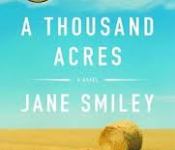
“A Thousand Acres”
What is a farmer?
A farmer is a man who feeds the world.
What is a farmer’s first duty?
To grow more food.
What is a farmer’s second duty?
To buy more land.
Why does a society value appearances, secrets, and hard work over basic human rights? And, what does it say about a society that condemns a victim for speaking out against a perpetrator for unspeakable crimes? These are the questions Jane Smiley seems to be asking in her Pulitzer Prize winning novel, A Thousand Acres. Published in 1991, A Thousand Acres refers to that magic number of acreage that most midwest farmers ascribe to own – a thousand acres of rich, fertile Iowa farmland. It’s the number that sets one farmer apart from another, especially if the land has been handed down from generation to generation and is unencumbered by a mortgage. Read more

Humans of New York: Stories
Several years ago, Brandon Stanton was an unemployed college graduate struggling to live in New York City when he began photographing people on the streets of New York City. Posting these pictures on a blog he created (www.HumansofNewYork.com), Stanton created an exhaustive fascinating visual catalog of life on the streets of the city, which caused a sensation on the internet. Soon, Stanton’s first book was published – Humans of New York – but Stanton sensed there was more to this photographic journey, that there was a human story behind each photograph which led him to publish Humans of New York: Stories – showing and telling the stories of strangers on the street. Read more
Alice Childress and the Wedding Band
The Negro woman has almost been omitted as important subject matter in the general popular American drama, television, motion pictures and radio. ~Alice Childress
When I first heard the name Alice Childress while visiting Oberlin College in Ohio, my curiosity was piqued. Who exactly was Alice Childress and why have I never heard of her? The answer to the first question is that Alice Childress (1916-1994) was an American actress, activist, union organizer, playwright, director, and author. She was also a black woman fighting for her voice to be heard and her talent recognized in industries dominated by white men. Read more
“Ingredients”
If food ingredient labels make your eyes glaze over, we hope that this book will open them instead.
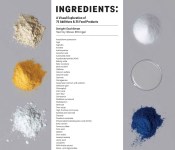
Steve Ettlinger and Dwight Eschliman (of Twinkie, Deconstructed and 37 or So Ingredients fame) came together to create a book –Ingredients: A Visual Exploration of 75 Additives & 25 Food Products – that is both appealing to the eye and the brain. Noting that “almost everyone eats processed foods,” the authors set the reader at ease by pointing out the word “processed” needs to be considered with care because we often forget that processed food also includes the freezing, cooking, baking, drying, and pickling of food – processes that get a bad rep when additives (especially those with complicated hard-to-pronounce names) are added. Read more

“Purity”
Secrets were power. Money was power. Being needed was power. Power, power, power: how could the world be organized around the struggle for a thing so lonely and oppressive in the having of it?
In Jonathan Franzen’s newest novel Purity, the author introduces the reader to Purity (“Pip”) Tyler, a 23-year old recent college graduate with $130,000 in student loan debt living in a squatter’s house in Oakland, California. Distancing herself from the mother who raised her in the Santa Cruz mountains, trying to find her biological father, and employed in a dead-end job, Pip is all but disillusioned about the world and the impact she will make on it. When offered an internship to work for the Sunlight Project – an organization that prides itself on leaking government secrets – in Bolivia, Pip takes a leap of faith, quits her job, packs up, and moves to South America. Read more
“Bettyville”
Everyday it becomes more apparent to me, and I think to her – a woman who still calls the refrigerator an “icebox” – that her world is gone and she is standing almost by herself now, the only one who remembers how it was here, wondering half the time what it is that people are talking about.
George Hodgman, a 54-year old magazine and book editor who recently lost his job returns home to Paris, Missouri (population 1,246) to care for his fiercely independent but ailing 91-year old mother. Struggling to take care of himself and Betty, George is frustrated, angry, and sad because he can’t quite figure out the road map that both and he and his mother are trying to navigate (“Betty and I are both crossing bridges we would rather avoid”). Read more


 Paddock Post