
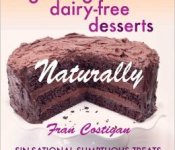
“More Great Good Dairy-Free Desserts Naturally”
Eat your fruits and vegetables but make sure you leave room for dessert, as long as the dessert tastes excellent and is made with healthful, honest ingredients…
Imagine a cake without butter, sour cream, milk, or eggs that actually tastes rich and delicious with a light crumb and moist texture. Hard to do? Not if you’re making one of the cakes made from a recipe in More Great Good Dairy-Free Desserts Naturally by Fran Costigan, a professionally trained pastry chef who has shown the world that desserts – and especially cakes – don’t need dairy products to be truly great and absolutely scrumptious. Read more 

Humans of New York: Stories
Several years ago, Brandon Stanton was an unemployed college graduate struggling to live in New York City when he began photographing people on the streets of New York City. Posting these pictures on a blog he created (www.HumansofNewYork.com), Stanton created an exhaustive fascinating visual catalog of life on the streets of the city, which caused a sensation on the internet. Soon, Stanton’s first book was published – Humans of New York – but Stanton sensed there was more to this photographic journey, that there was a human story behind each photograph which led him to publish Humans of New York: Stories – showing and telling the stories of strangers on the street. Read more
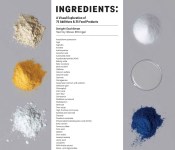
“Ingredients”
If food ingredient labels make your eyes glaze over, we hope that this book will open them instead.
Steve Ettlinger and Dwight Eschliman (of Twinkie, Deconstructed and 37 or So Ingredients fame) came together to create a book –Ingredients: A Visual Exploration of 75 Additives & 25 Food Products – that is both appealing to the eye and the brain. Noting that “almost everyone eats processed foods,” the authors set the reader at ease by pointing out the word “processed” needs to be considered with care because we often forget that processed food also includes the freezing, cooking, baking, drying, and pickling of food – processes that get a bad rep when additives (especially those with complicated hard-to-pronounce names) are added. Read more
“Bettyville”
Everyday it becomes more apparent to me, and I think to her – a woman who still calls the refrigerator an “icebox” – that her world is gone and she is standing almost by herself now, the only one who remembers how it was here, wondering half the time what it is that people are talking about.
George Hodgman, a 54-year old magazine and book editor who recently lost his job returns home to Paris, Missouri (population 1,246) to care for his fiercely independent but ailing 91-year old mother. Struggling to take care of himself and Betty, George is frustrated, angry, and sad because he can’t quite figure out the road map that both and he and his mother are trying to navigate (“Betty and I are both crossing bridges we would rather avoid”). Read more
“Truth and Beauty”
She couldn’t see that no one else was perfect either, and that so much of love was the work of it.
Lucy Grealy (1963-2002) was 39 years old when she died of a heroin overdose in a friend’s apartment in New York City a few days before Christmas. Sad, lonely, and depressed, Grealy endured three decades of both physical and emotional pain before taking her life. A talented poet and writer, Grealy’s most recognized piece of work was “Autobiography of a Face” (1994) which recounted her experience with cancer of the jaw and the resulting disfigurement caused by dozens of surgical procedures both intended to save her life and reconstruct her face. Read more
“Relish”
Graphic novels are not traditional literature, but that does not mean they are second-rate. Images are a way of writing. When you have the talent to be able to write and to draw, it seems a shame to choose one. I think it’s better to do both. ~Marjane Satrapi
Several months ago, my daughter told me she was reading a graphic novel and I’m ashamed to admit I thought she was reading a book with a triple “X” rating attached to it. Always trying to be open-minded, I asked a few questions and realized a graphic novel is simply a novel in comic strip format. Totally embarrassed by my ignorance, I made a note to self: stay better informed of current trends in young adult culture. Read more
“What the Dog Saw and Other Adventures”
A lot of my process is informed by the notion that two mildly good stories put together sometimes equal one really good story.
What the Dog Saw and Other Adventures by Malcolm Gladwell was published in 2009, although the 19 non-fiction essays included in the book were originally published in The New Yorker magazine where the author has been a staff writer since 1996.
Divided into three parts with three themes: obsessives, theories (ways of organizing experience), and the predictions we make about people, What the Dog Saw and Other Adventures is one of the most interesting contemporary collections of stories that anyone over the age of 40 can relate to without having to refer to Wikipedia for an explanation of events, characters, products, and businesses. Read more

“Zealot”
The more I probed the Bible to arm myself against the doubts of unbelievers, the more distance I discovered between the Jesus of the gospels and the Jesus of history – between Jesus the Christ and Jesus of Nazareth.
Zealot: The Life and Times of Jesus of Nazareth by Reza Aslan was given to me to read by a Jewish friend, who told me “you have to read this book.” He had recently attended a gathering where the keynote speaker was Reza Aslan – an American-Iranian writer and academic in religious studies and creative writing – and was mesmerized by both the author and the book. Read more
“Such Good Girls”
I knew I was Jewish, but I didn’t know I was Jewish.
There are hundreds if not thousands of books in print about the Holocaust, most of which cover the Nazi regime, concentration camps, survivors of the camps, and the political environment but there are very few books about the “hidden children” – the infants, toddlers, and school age children – who were hidden, often in plain sight of the Nazis during World War II, and survived.
These children grew up, often left Europe, and for the most part were silent because they were taught to stay quiet to avoid detection, didn’t know if they could trust their memories, and didn’t have the resources to process what had happened to them. And so, very little has been written about them because so little has been known, until recently. Read more

“The Omnivore’s Dilemma”
Much of our food system depends on our not knowing much about it, beyond the price disclosed by the checkout scanner; cheapness and ignorance are mutually reinforcing. And it’s a short way from not knowing who’s at the other end of your food chain to not caring–to the carelessness of both producers and consumers that characterizes our economy today. Of course, the global economy couldn’t very well function without this wall of ignorance and the indifference it breeds. This is why the American food industry and its international counterparts fight to keep their products from telling even the simplest stories–”dolphin safe,” “humanely slaughtered,” etc.–about how they were produced. The more knowledge people have about the way their food is produced, the more likely it is that their values–and not just “value”–will inform their purchasing decisions.”
Very simply, we subsidize high-fructose corn syrup in this country, but not carrots. While the surgeon general is raising alarms over the epidemic of obesity, the president is signing farm bills designed to keep the river of cheap corn flowing, guaranteeing that the cheapest calories in the supermarket will continue to be the unhealthiest. ~Michael Pollan


 Paddock Post