
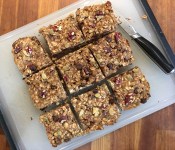
Oat Bars
One of the challenges of eating a plant-based diet is finding ways to make desserts with little or no oil and no refined sugar. But, the challenge is deeper than that because a truly nutritious treat is also about what is included. Ideally, ingredients that stand alone as nutritious and delicious.
I started with a recipe called Pumpkin Seed and Chocolate Chip Oatmeal Breakfast Bars by Dreena Burton and adapted the ingredients to come up with a recipe for Oat Bars that contain whole grain oats, whole grain oat flour, seeds, nuts, spices, date syrup, dark chocolate chips, and non-dairy milk. Basically, these bars are whole-grain and plant-based with no dairy, no oil, no refined sugar, and no eggs.
Oat Bars have a base of rolled oats and oat flour whose flavor is enhanced with what I call “the big 3” – pumpkin seeds, walnuts, and dark chocolate chips. The big 3 are simply three wholesome ingredients that are super tasty together. But, if you find raisins, walnuts, and sunflower seeds more to your liking, make a substitution. Read more 

Dr-Cow Raw Chocolate Bricks
One of the great benefits of following a plant-based diet is enjoying dark chocolate whose subtle differences in taste, texture, and aroma become more pronounced over time. Acquiring a taste for dark chocolate evolves but once you’ve come to appreciate the purity and intensity of dark chocolate, you’ll never want to eat milk chocolate ever again. The difference is really that striking.
Dr-Cow, a small storefront in the Williamsburg neighborhood of Brooklyn is known for making organic, raw, dairy-free, egg-free, gluten-free, and soy-free food products, especially tree nut cheese, granola, biscotti, crackers, desserts, and chocolates. Read more

Where Does $100 to the American Lung Association Go?
The American Lung Association (ALA) was established more than 100 years ago (1918) initially to fight tuberculosis but expanded its mission to improve lung health and preventing lung disease through research, education, and advocacy.
Specifically, ALA works to “defeat” lung cancer, “improve” the air we breathe, “reduce” the burden of lung disease on individuals and families, and “eliminate” tobacco use and tobacco-related diseases. To do this, the organization relies on staff (626 people) so the organization is a non-profit (a 501 (c) (3)) that primarily provides services rather than a grant maker (ALA made $8 million in grants in 2018). Read more

Executive Compensation at the American Lung Association
In 2017, the American Lung Association (ALA) underwent big changes when the eight charter and national boards voted to unite the organization into a single nationwide organization. A 501 (c) (3) based in Chicago, Illinois, the ALA raised about $108 million in 2018, spent $104 million (primarily on compensation, fees for services, direct mail, and office-related expenses), and had about $148 million in net fund assets (think savings account) at year-end.
The ALA reported having 626 employees in 2018 who were compensated nearly $46 million, which equates to an average compensation of $74,500. 30 employees received more than $100,000 in compensation with the 18 most highly compensated employees listed below: Read more
Executive Compensation at Aurora Health Care
Aurora Health Care is a health care provider for 30 communities in eastern Wisconsin and northern Illinois with 15 hospitals, more than 150 clinics, and 70 pharmacies. In addition, Aurora Health care has approximately 700 clinical research projects including more than 400 clinical trials going on.
The most recent IRS Form 990 (2016) reports the organization – a 501 (c) (3) based in Milwaukee, Wisconsin – reported total revenue of $4.629 billion, almost all of which came from program services. Expenses totaled $4.287 billion (including $140 million in depreciation) concentrated in three areas: compensation ($2.252 billion), payments to affiliates ($807 million), and medical supplies/equipment rental/hospital tax assessment ($752 million). Aurora Health Care had $342 million in excess revenue which contributed to the organization’s ability to increase the net assets or fund balance from $4.485 billion in the beginning of the year to $4.836 billion at year-end.
In 2016, the organization employed 29,543 employees who were compensated $2.252 billion, which equates to an average compensation of $76,500. 3,155 employees received more than $100,000 in compensation with the 87 most highly compensated employees listed below: Read more
Executive Compensation at Allina Health System
Allina Health System is a non-profit health care provider based in Minneapolis that owns or operates 13 hospitals and more than 90 clinics through Minnesota and Wisconsin.
In 2016, total revenue was $4.104 billion while total expenses were $4.073 billion (including $170 million in depreciation). The three largest expenses were compensation ($2.5 billion), office-related ($767 million), and fees for services ($383 million). The net assets or fund balance at the beginning of the year was $2.330 billion. After adding excess revenue ($31 million) and net unrealized gains on investments and other changes in assets ($37 million), the net assets or fund balance was $2.398 billion at year-end. Read more
Executive Compensation at Dignity Health
Dignity Health is one of the largest non-profit healthcare providers in the United States. Headquartered in San Francisco, Dignity Health is the largest hospital provider in California although this 501 (c) (3) serves communities in 21 states.
The most recent IRS Form 990 available (2016) for the year ending June 30, 2017 for Dignity Health (the administrative entity only – note: there are numerous 501 (c) (3’s) in which Dignity Health is the direct controlling entity) reported $9.9 billion in revenue, $9.8 billion in expenses (including $480 million in depreciation). At the beginning of the year net fund assets were $4.2 billion but after adding in excess revenue, unrealized gains on investments, and changes in assets, Dignity Health closed the year with $5.1 billion.
In 2017, Dignity Health reported having 54,608 employees who were compensated $5.2 billion (about 50% of the revenue), which equates to an average compensation of $94,500. 13,933 individuals received more than $100,000 in compensation with the 33 most highly compensated individuals listed below: Read more

Mu Mu Muesli
Simply the best cereal on the market.
Muesli is a breakfast cereal made up of raw rolled oats, grains, dried fruits, nuts, and seeds that is typically enjoyed with your favorite type of milk or yogurt (note: I find it especially delicious with unsweetened Milkadamia – a non-dairy nut milk).
Some people claim that muesli is just raw granola but that description doesn’t do the Swiss invention justice. While many of the ingredients are the same, muesli differs from granola in three ways: muesli is not baked, does not contain oil, and typically has no added sweeteners. Read more

Where the Crawdads Sing
Never run in town or people’ll think you stole something.
Where the Crawdads Sing is the first book of fiction published by Delia Owens, an author known more for the non-fiction books (The Eye of the Elephant, Cry of the Kalahari, and Secrets of the Savanna) she co-authored with Mark Owens about her experiences as a wildlife scientist in Africa. With the same attention to detail and observation made in previous books, Owens writes a coming of age novel about a young girl growing up in the marshlands of North Carolina in the 1950’s and 60’s, which is rumored to be partially autobiographical. Read more

Where Does $100 to EDESIA go?
EDESIA is a 501 (c) (3) based in North Kingston, Rhode Island that produces high quality ready-to-use food under a license from Nutriset (a French company whose focus is on producing food to prevent and reverse malnutrition). EDESIA manufactures these food packets and sells them to organizations who distribute the products in the developing world. Hence, the primary source of revenue is from the sale of these products (primarily to other non-profits).
In 2017, EDESIA reported $40 million in revenue, $37 million of which came from product sales. The remaining revenue came from government grants and contributions. Read more


 Paddock Post