
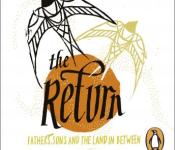
The Return
The country that separates fathers and sons has disoriented many travelers.
Many Americans associate Libya with the September 11, 2012 uprising in Benghazi where Islamic militants attacked the American consulate killing the US Ambassador to Libya, J. Christopher Stevens and three others. To better understand Libya and the historical events that define its tumultuous past, it is helpful to know the following: Read more 
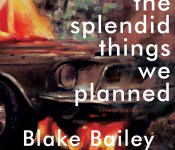
The Splendid Things We Planned
Blake Bailey is best known for his biographies of very talented but troubled writers (Yates, Cheever, and Jackson) so when The Splendid Things We Planned – a personal family memoir – was published in 2014, readers took note because it’s one thing to write about other people’s lives but quite another to open the flood gates on your own family. Read more
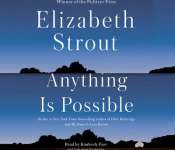
Anything Is Possible
Before you pick up the book, Anything Is Possible by Elizabeth Strout, do yourself a favor and read My Name is Lucy Barton first. Both books stand alone as good reads but collectively these fictional stories are even better because the first book sets the stage and introduces a cast of colorful characters whose lives intertwine in the most bizarre ways in the second book. Read more
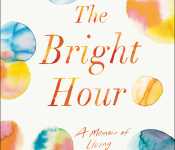
The Bright Hour
In 1838, 35-year old Ralph Waldo Emerson sat down and wrote in his journal:
I am cheered with the moist, warm, glittering, budding and melodious hour that takes down the narrow walls of my soul and extends its pulsation and life to the very horizon. That is morning; to cease for a bright hour to be a prisoner of this sickly body, and to become as large as the World.
Nearly 200 years later, Emerson’s great-great-great granddaughter, Nina Riggs found profound meaning in that entry and named the book she finished a month before her death at age 39, in February, 2017, “The Bright Hour.” When the reader fully absorbs that journal entry, it’s as if the generations between Emerson and Riggs disappear and that these two people born 174 years apart shared a connection, a knowledge of how hard it is to live when the body is failing, and the beauty of experiencing something so simple – daybreak – to alleviate the suffering. Although Emerson recovered and went on to live another 44 years, dying at the age of 78, Riggs was not so lucky. Read more
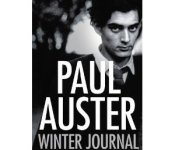
Winter Journal
Your eyes water up when you watch certain movies, you have dropped tears onto the pages of numerous books, you have cried at moments of immense personal sorrow, but death freezes you and shuts you down, robbing you of all emotion, all affect, all connection to your own heart.
On the eve of Paul Auster’s 64th birthday, the author sat down and penned a memoir called Winter Journal. Published in 2012, Winter Journal is not an “I did this; I did that” account of his life (although there is a bit of time-centered personal detail in the book) but more of a “I felt this; I felt that” type of story as he recalls how he reached a milestone where the world no longer considered him young or even middle-aged. Read more
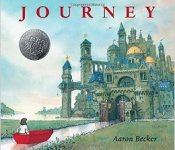
Journey
A picture is worth a thousand words.
People often talk about the power of words but consider for a moment the power of pictures. The well-known saying “A picture is worth a thousand words” is easily understood when we think of the Mona Lisa or American Gothic but the meaning takes on a whole new dimension when applied to a children’s picture book called Journey by Aaron Becker, a man who has been known to say his favorite destination remains in his imagination. Read more
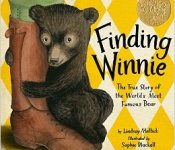
Finding Winnie
The heart of this story, to me, has always been that you never know the impact one small, loving gesture can have. It is the dedication to my son Cole and it is the one piece I hope all readers will take away from Finding Winnie. ~Lindsay Mattick
Finding Winnie is the true story of a baby bear rescued by a veterinarian in White River, Canada just as World War I was beginning in 1914.
Harry Colebourn was living in Winnipeg when he had to say good-bye to his family and friends before traveling across Canada to reach an oceanliner that would take him to Europe where he would serve as a veterinarian for the Canadian army’s horses. When the train stopped in White River, Canada, Colebourn noticed a man sitting on bench holding on to a rope tied to a baby bear. He offered the man $20 for the baby bear and the rest is history. Read more
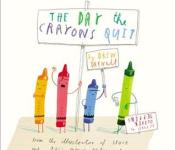
The Day the Crayons Quit
The battle lines have been drawn.
Every office in the country should have a copy of The Day the Crayons Quit lying around. People may scoff, roll their eyes, and even think that someone left their kid’s book at the office or the waiting room by mistake, but don’t turn away. Pick up the book and read it. Maybe it’s been a few years since you’ve read a children’s book (if you’re not the proud parental unit of a child under the age of 10, then it’s probably been a while). This one’s worth it. Read more
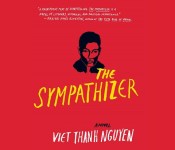
The Sympathizer
Vietnam is a country, not a war.
The war known as the “Vietnam War” was fought by the generation before mine from the early 1960’s until 1975. In the most simplistic terms, the Vietnam war was a civil war between North and South Vietnam (sound familiar?) with the North Vietnamese and the Viet Cong (a South Vietnamese Communist group) fighting to reunify Vietnam under a communist rule.
The US became involved in the conflict to prevent communism from spreading because the American leaders felt threatened by democracy’s counterpart. Russia and China backed North Vietnam while the US, South Korea, Australia and several other countries backed South Vietnam. After years of fighting, the North Vietnamese captured Saigon in 1975 ending the war (the US lost) and the two regions were reunified into a communist country. Read more
Life Among the Savages
Sometimes a book reminds readers that our lives never really change despite the outside factors that seem to change daily. We write but the computer has replaced the typewriter, we raise children but the social norms change; we drink milk but we buy the containers at the grocery store instead of having them delivered; and we drive cars but with seat belts and air bags. Yes, progress allows us to do things differently but it doesn’t take away the core aspects of our lives: to grow, learn, love, procreate, work, eat, survive, struggle, and die. Life Among the Savages is just that book. Read more


 Paddock Post